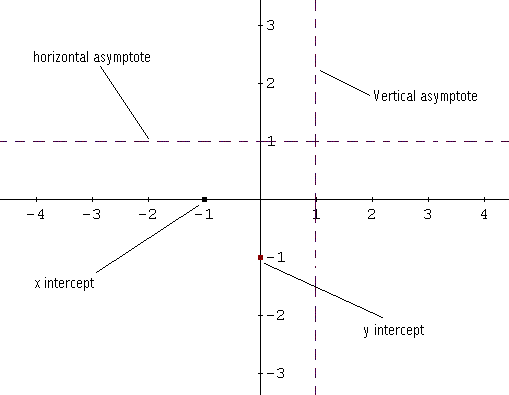
10. While the domain of a rational depends on DIVAH, what do you think the range of a rational function depends on? Give an example.
DIVAH stands for Domain Is Vertical Asymptotes and Holes. The vertical asymptotes and holes are the things that restrict our graph. Our domain will be everything except this bad values. The range is the y-values. We can get a bad y-value from a hole, but we can't get one from a vertical asymptote. We get bad y-values from horizontal asymptotes, but they don't always produce range restrictions because a graph can cross through the middle of a horizontal asymptote. Our range will depend on horizontal asymptotes and holes.
Wednesday, September 26, 2012
Unit G Summary Question # 9; X- intercepts
9. Describe how to find the x-intercepts of a rational function. Include both the long way and the shortcut way, explaining why the shortcut makes mathematical sense.
There are two ways to find the x-intercepts for a rational function. There is a long way and a shortcut way. the long way is illustrated below. First we set our function equal to zero. Then we multiply and the denominator will get canceled. Next, we factor the polynomial. Once we have the factors we set them equal to zero and we put them into ordered pairs to get our x-intercepts. The shortcut way is similar to the long way but it has less steps. In the short cut we simply set the numerator equal to zero, factor it, solve and we have our x-intercepts. The shortcut way makes sense because when we cancel the denominator in the long way, we only concentrate on the numerator. In the shortcut we immediately start working with the numerator so that's why the shortcut makes sense.
Unit G Summary Question # 6; Holes
6. How do we find the appropriate place to put a hole if the y-value is undefined when plugged into the original equation?
First of all, we know that to find out holes we need to factor our equation. We say "factor the top and if something cancels then your graph will have a hole". We factor our equation and we see that we can cancel , let's say (x -1). We cancel those to factors and our hole will be at (1,_). When we plug in 1 in our calculator, it is undefined so we need to plug it into our factored equation. The answer we get when we solve is the y-value for our hole. Our hole will be at for example, (1,3). That is the actual value for our hole but on our calculator, it will show up as undefined.
Tuesday, September 25, 2012
Student Video # 1: Unit F Concept 10
- What is this video about?
- This video
covers a problem from unit F Concept 10, which is finding all zeroes of a
polynomial when the zeroes could be real and or irrational/
imaginary.We chose problem number two from page 13 of the SSS. In this
video we go over the steps to finding zeroes. Which is finding the p's
and q's, doing the sign changes, synthetic division,
and doing the quadratic formula to find
the irrational zeroes.
- What does the
viewer need to pay special attention to in order to understand the
concept?
- In
this problem, we have a list of six p's and q's so the viewer needs to
make sure they find all of them.
- Also,
it was difficult to do the synthetic division because there are
many numbers to choose from, so you just need to make an educated
guess and try
to pick the numbers that will give you zero heroes.
Unit G Summary Question # 4; Vertical Asymptotes and Holes
4. What is the difference between a graph having a vertical asymptote and a graph having a hole?
In the example below, the graph has a vertical asymptote and a hole. When a graph has a vertical asymptote, it means that it has a vertical line going though it at some number value. In the example below, the vertical asymptote is at x= -1/2. It is important to remember that graphs can never cross through vertical asymptotes.When a graph has a hole, it means that the graph does not exist at that point. In the example below, the graph has a hole at (0,1). When you plug this function into your graphing calculator, and trace to x=0, there will be no x value. That is because we have a hole and there is no value there. Holes are written as ordered pairs such as (1,3) and vertical asymptotes are written as an equation like x = 3.
Unit G Summary Question # 8; Y- Intercepts
8. How do you find the y-intercept of a rational function? Does this need to be done in the original or simplified equation?
There are two ways in which we can find the y-intercept of a rational function. The first way is by plugging in zero into our original equation. Or as shown below, we can use the factored equation and plug zero in there. We will get the same answer from the original equation and the factored equation. There is one exception to finding the y- intercept and that is when we have a hole at the y-intercept. If we have a hole at the y-intercept, then our answer will be zero over zero and were going to have to use the factored form in order to find the real value for the y-intercept.
Unit G Summary Question # 7; Limit Notation for Vertical Asymptotes
7. Describe how to write the limit notation for vertical asymptotes and what the notation means.
To write the limit notation for vertical asymptotes, we use the value that we got got for the vertical asymptote. When we do limit notation for vertical asymptotes, we use little pus and minus signs. The little plus sign means "from the right side". The little minus sign means "from the left side". The notation means "as x approaches a number from the right, the graph goes up" or "as x approaches a number form the left the graph goes down". Here is an example of limit notation for vertical asymptotes:
As
x → 2 +, f(x) → ∞
As
x→ 2 -, f(x) → -∞
Monday, September 24, 2012
Unit G Summary Question #5; Asymptotes
5. Describe the conditions in which a graph can cross through an asymptote.
There are some conditions in which a graph can cross through an asymptote. First, we have horizontal asymptotes. The graphs for horizontal asymptotes can cross through the horizontal asymptotes but only if it crosses towards the middle of the graph. It can NEVER cross towards the far left or far right of the graph. Next, we have slant asymptotes. Like horizontal asymptotes, the graph for slant asymptotes can sometimes cross towards the middle of a graph. Finally we have vertical asymptotes. The graphs for vertical asymptotes can NEVER EVER cross through a vertical asymptote.
Unit G Summary Question # 3; Slant Asymptotes
3. When does a graph have a slant asymptote? How do you find the equation of the slant asymptote?
Slant asymptotes can only exist if the degree from the numerator is ONE BIGGER than the degree on the bottom. This means that if we have the function (x^2-1)/(x-2), we will have a slant asymptote because we have x^2 on the top and x on the bottom. The equation for the slant asymptote is y=mx+b. To find the equation for a slant asymptote, first we need to do long division. Once we have our answer, we will use everything but the remainder and that will be the equation for the slant asymptote.
Sunday, September 23, 2012
Unit G Summary Question # 2; Horizontal Asymptotes Limit Notation
2. Describe what the limit notation for horizontal asymptotes actually means.
The limit notation for horizontal asymptotes has plus and minus signs included. Instead of saying "as x approaches infinity, the graph goes up" , we are now saying as we go right (or left) we approach as number. Next to infinity there is a positive sign next to it to indicate that it is positive. For asymptotes, the limit notation is different because we do not say if the graph is going up or down. We state which number it is getting close to.
I could't find a picture for limit notation so I'm going to put an example below:
As x → + ∞,
f(x) → 2
As
x → - ∞, f(x) → 2
The limit notation for horizontal asymptotes has plus and minus signs included. Instead of saying "as x approaches infinity, the graph goes up" , we are now saying as we go right (or left) we approach as number. Next to infinity there is a positive sign next to it to indicate that it is positive. For asymptotes, the limit notation is different because we do not say if the graph is going up or down. We state which number it is getting close to.
I could't find a picture for limit notation so I'm going to put an example below:
As x → + ∞,
f(x) → 2
As
x → - ∞, f(x) → 2Unit G Summary Question # 1: Horizontal Asymptotes
1. How do we know if a graph has a horizontal asymptote? What are the three options?
To determine whether a graph has a horizontal asymptote, we need to compare the degrees of the numerator and the denominator. If the bigger degree is on the bottom then the asymptote is y = 0. If the coefficients have the same degree, the asymptote is equal to the ratio of the coefficients. Lastly if the bigger degree is on the bottom, then there is no asymptote. Sometimes the graphs cross through a horizontal asymptote. It is okay if they cross towards the middle of the graph. It is never okay if they cross towards the far left or far right.
Subscribe to:
Posts (Atom)