Dear Incoming Math Analysis Students,
My name is Josefina and I took Math Analysis during my senior year.
First of all, I want to wish you all luck on the upcoming year! I hope you are all prepared and excited for Mrs. Kirch's class! My experience with Math Analysis was difficult but it was also fun. The most difficult part of Math Analysis was getting used to watching videos instead of having an in-class lecture. The best advice I can give you is to not slack off on your homework, especially the summer assignment! It was hard for me to keep up with the homework for this class because I had other classes and AP's to worry about, but I had to make time for this class so that my grade wouldn't go down. It is also important to do the summer assignment because if you don't do it you will fall behind the rest of your class. I also want you guys to go into Mrs. Kirch's class with a positive attitude and an open mind. The most important thing in this class is to be able to accept change and the different rules that Mrs. Kirch has set up.
The best way to adjust to the flipped classroom is to keep an open mind. At first, you guys will feel overwhelmed with all the new things that are you are exposed to, but pretty soon you will get used to it. In the flipped classroom, Mrs. Kirch required us to make our own videos as assignments. The first video that I recorded was in Mrs. Kirch's class and it was difficult for me the first time. It was difficult because I had never recorded a video before but by the end of the year, we had recorded a lot of videos and I felt that I got better at it. The most difficult part about recording videos was getting the right equipment to record the videos, but if this this a problem for you, Mrs. Kirch has the supplies for you to record your video. I would also advise you to keep up with your work in class! This is important because you will regret it if you slack off. Mrs. Kirch sets up recommended deadlines for work and it is a good idea to follow them.
The flipped classroom is very different from a normal classroom.The biggest change is the video lessons. In Math Analysis, we need to watch videos at home to learn the material and in class, we do practice problems that would normally be assigned homework. Another difference in the flipped classroom is that we do not use our textbook at all. Mrs. Kirch creates her own packets (the SSS) that we used instead of the textbook, so don't expect to be using your Math Analysis book frequently. As you can see, Mrs. Kirch had us set up our own blog and we used this blog to do a majority of our homework assignments. This blog was hard to keep up with because some of the assignments we had were difficult. The biggest difference between a flipped classroom and a normal classroom was the homework we were assigned because we don't have the usual textbook assignment, we have videos and blog posts for homework.
Please keep an open mind towards the flipped classroom, it well help a lot!
Have fun in Math Analysis next year, Mrs. Kirch is an awesome teacher!
Wednesday, June 5, 2013

Monday, June 3, 2013
Unit V Big Question

Sources:
http://www.coolmath.com/precalculus-review-calculus-intro/precalculus-algebra/24-the-difference-quotient-01.htm
Sunday, May 19, 2013
Unit U Big Questions
1. What is continuity? What is discontinuity?
Continuity is the unbroken and consistent existence of something over a period of time. This means that something continues forever. An example of this would be a linear function. Discontinuity is a point at which a graph or a function is discontinuous. This means that something happens in the graph that causes it to become discontinuous, or broken. An example of a discontinuity is a point discontinuity which is a hole, jump discontinuity which is when the left and right side are different, unbounded behavior which is an asymptote, or oscillating behavior which is when the graph is wiggly.
2. What is a limit? When does a limit exist?When does a limit not exist? What is the difference between a limit and a value?
A limit is the intended height of the function. A limit exists when you reach the same height from both the left and right side of the graph. Both the left and the right side must be the same in order for the limit to exist. A limit does not exist when there are discontinuities in the graph such as asymptotes and jump discontinuities. The limit still exists when there is a point discontinuity (hole) because even though there is a hole at that point, the graph still reached its limit or its intended height. The difference between a limit and a value is that a limit is the intended height of a function and the value is the actual height of a function.
3.How do we evaluate limits numerically, graphically, and algebraically?
We evaluate limits numerically by using a table. When we do this, we list the values from the left and the values from the right and we determine the limit based on the number that the values from the left and the right approach. We evaluate limits graphically by using a graphing calculator or by looking at a picture of the graph. When we use our graphing calculator, we simply need to graph the function and trace to an x-value to see what the limit is. When we are given a picture of the graph, we can just look at the x-values and see what the limit is. Lastly, we can evaluate limits algebraically by using the direct substitution method. The direct substitution method is when you take the number the limit is approaching and plug it in anytime you see "x'.
Works Cited:
http://mathworld.wolfram.com/Discontinuity.html
Thursday, April 25, 2013
Big Question Blog Post # 3
Why is a normal tangent graph uphill, but a normal cotangent graph downhill. Use the unit circle ratios to explain.
The way that the tangent or cotangent graph faces has to do with the asymptotes and with the quadrants where tan/cot is positive or negative in. A normal tangent graph has asymptotes where it is undefined or where x is equal to zero, this will be at 90 degrees and at 270 degrees. After we figure out where our asymptotes are, we need to look at the positive and negative signs and we can draw the curves from there. The pattern for tangent is + - + - so first we draw the graph going upward, then downward, then upward,and downward again.
A normal cotangent graph goes downhill because we know that cot= x/y. There will be asymptotes where y equals zero and that will be at zero degrees and at 180 degrees. Next, we need to look at the pattern again, first it is positive, then negative. When we draw the positive side, we need to draw it above the x-axis and when we draw the negative side, we need to draw it below the x-axis.We need to start drawing our graph at the nearest asymptote so that is can go downhill That is how we know that cotangent goes downhill.
Big Question Blog Post # 4
Why do sine and cosine NOT have asymptotes, but the other for trig graphs do? Use unit circle ratios to explain.
Sine and cosine will never have asymptotes. Sine does not have asymptotes because sine is equal to y/r. We know that "r" can never equal zero and in order for us to have asymptotes we need to have zero in the denominator because asymptotes only have when something is undefined. Cosine is equal to y/r and since we know that "r" can't be equal to zero, it can't have any asymptotes.
Tangent and Cotangent have asymptotes because tangent equals y/x and cotangent equals x/y. Tangent and cotangent can have asymptotes because based on the unit circle, there are some angles there where x is zero or y is zero. Remember, asymptotes are formed when we have an undefined value or any number divided by zero. We can have asymptotes in tangent and cotangent because the quadrant angles have zeros in their ordered pairs and those zeroes give us asymptotes.
Wednesday, April 24, 2013
Big Question Blog Post #2
How do the graphs of sine and cosine relate to the others? Emphasize asymptotes in your response.
a. Tangent: The sine and cosine graphs relate to the tangent graphs because we need to go through the same process to graph these trig functions. The sine and cosine graphs relate to the tangent graphs because tangent equal sine/cosine, so if we were to graph sine and cosine on the same graph, we would know where to graph tangent. We also know that since tangent equals sine/cosine we will have an asymptote where cosine is equal to zero.
b. Cotangent: Sine and cosine graphs relate to tangent graphs because we know that cotangent equals cosine/sine. When we graph cotangent, we know that we will have asymptotes where sine is equal to zero. The only reason that we have asymptotes is because we have a value divided by zero so it makes it undefined and we get an asymptote.
c. Secant: The sine and cosine graphs relate to secant because secant is the reciprocal of cosine. When we graph secant, we sketch the cosine graph first. The reason that we sketch the cosine graph first id so that we can now where we need to draw the asymptotes and the little parabolas that go on the graphs. Secant is related to sine and cosine because secant is the reciprocal of cosine.
d. Cosecant: Cosecant is related to sine and cosine because cosecant is the reciprocal of sine. When we graph cosecant, we start with the same process for graphing sine. We need to lightly sketch the sine graph because it will be our guide to draw our cosecant graph. Then we draw the shifts and draw the parabolas where those shifts are located. Cosecant is related to the seine and cosine graphs because cosecant is the reciprocal of sine.
Big Question Blog Post #1
How do the trig graphs relate to the Unit Circle?
The trig graphs relate to the unit circle because when we graph a trig function, we are basically taking the unit circle and stretching it into a line. We also need to look at ASTC to know how the trig graphs relate to the unit circle. Sine's pattern is positive, positive, negative, negative. That means that in the first two quadrants sine is positive and in the next two quadrants, sine is negative. When we graph sine, the first two sections are above the x-axis because they are positive. The next two sections of the sine graph are below the x-axis because sine is negative in quadrants three and four. In the picture below, we see how the sine graph relates to the unit circle because we know that the sine of 90 is one and that is shown on the graph. The cosine and tangent graphs also relate to the unit circle based on the pattern they have. For example, cosine's pattern is positive, negative, negative, positive. Tangent's pattern is positive, negative, positive, negative.

a. Period: The period for sine and cosine is 2 pi and the period of tangent and cotangent is pi. The period for sine is 2 pi because the pattern for sine and cosine takes two periods to to repeat. The pattern for sine is + + - - and the period for cosine is + - - +. The period for sine and cosine because their respective patterns take two periods to repeat. The period for tangent and cotangent is only one period long because the pattern only takes one period to repeat itself. The pattern for tangent is + - + -.
b. Amplitude: Amplitude is the distance between the lowest point and the highest point on the graph. We know that sine and cosine have amplitudes because of the values on the unit circle. Tangent and cotangent don't have amplitudes because those graphs go uphill and downhill. Since these graphs go uphill and downhill, it is not necessary to have an amplitude.
The trig graphs relate to the unit circle because when we graph a trig function, we are basically taking the unit circle and stretching it into a line. We also need to look at ASTC to know how the trig graphs relate to the unit circle. Sine's pattern is positive, positive, negative, negative. That means that in the first two quadrants sine is positive and in the next two quadrants, sine is negative. When we graph sine, the first two sections are above the x-axis because they are positive. The next two sections of the sine graph are below the x-axis because sine is negative in quadrants three and four. In the picture below, we see how the sine graph relates to the unit circle because we know that the sine of 90 is one and that is shown on the graph. The cosine and tangent graphs also relate to the unit circle based on the pattern they have. For example, cosine's pattern is positive, negative, negative, positive. Tangent's pattern is positive, negative, positive, negative.
b. Amplitude: Amplitude is the distance between the lowest point and the highest point on the graph. We know that sine and cosine have amplitudes because of the values on the unit circle. Tangent and cotangent don't have amplitudes because those graphs go uphill and downhill. Since these graphs go uphill and downhill, it is not necessary to have an amplitude.
Monday, April 15, 2013
Assessment # 4
1. What is this problem about?
This problem is
from Unit S Concept 7. Concept 7 is about solving equations with half-angle
formulas. This video will go over number 3 from the SSS.
2. What does the viewer need to pay attention to in order to do the problem correctly?
The first thing
that we need to do is replace the half angle of sine with its half angle
formula. There is a radical in the formula, so later in the problem we
square both sides to get rid of the radical. When we square both sides we need
to remember to check for extraneous solutions. The most important thing about
this problem is to check for extraneous solutions because some of the
answers we get may be wrong.
Sunday, April 14, 2013
Assessment #3
1. What is this problem about?
This is a problem from Unit S Concept 3 Number 1 from the SSS. Concept 3 was about using the power reducing formulas. For this concept, the viewer has to keep in mind that we want the highest power to be one.
2. What does the viewer have to pay attention to in order to do the problem correctly?
The viewer needs to remember that the highest power has to be one, so they need to reduce everything else that is bigger than one. The viewer also needs to follow each step because these problems can get tricky and the process is kind of long.
Assessment #2
I chose to work with the angle 105.


In Unit R, we solved it with the sum and difference formulas

In Unit S, we learned how to solve it with half angles

In both pictures, the same angles was used in the problems. In the first picture we solved by using the sum and difference formulas. This means that we used two angles that added up to 105 degrees, in this case the angles were 60 and 45. then we used the ordered pairs from the unit circle and plugged them into the formulas to solve. In Unit S, we learned about half-angles. Basically, we can solve for an angle that is not on the unit circle by using an angle that is on the unit circle and diving it by two. Then we use the ordered pair from the unit circle and plug it into the formulas to solve. We know that these answers are the same because we used the same angle in both of the problems. In one of the pictures, we added two angles to make 105 and in the second picture we divided an angle by two to get 105. Since we used values from the unit circle, the answers were the same because the ordered pairs on the unit circle are similar to each other. To prove that the answers in both of the pictures are the same, we can plug them into our calculator and compare the decimal answers.
Wednesday, March 27, 2013
Unit R Concept 3: Student Problem
The problem that I chose to do is sin(sin-1(½) + cos-1(rad. 2/2)


1. What is this problem about?
This problem is from Unit R Concept 3. This concept is about doing the trig of an inverse trig function. To do this we need to use the sum and difference formulas to prove.
2. What does the viewer need to pay close attention to in order to do the problem correctly?
In order to do this problem correctly, we need to choose the correct angles first. If we choose the wrong angles, we will not get the correct answer. Also, in some problems, there will be more than one possible angle choice so we need to make sure that we use the angle in the first quadrant.
Tuesday, March 26, 2013
Unit R Concept 2: Student Problem
 |
| This is the problem that I will solve for Unit R Student Problem 2 |
 |
| This picture shows what we get when we solve for sin(u+v) |

This is the work that we need to show when we solve for tan(u-v)
1. What is this problem about?
This problem is from Unit R Concept 2. Concept 2 is about using sum and difference formulas when given values. In this concept we had to use right triangles and Pythagorean Triples to solve.
2. What does the viewer need to pay close attention to in order to do the problem correctly?
In Concept 2, we had to deal with quadrant 2 and quadrant 3 triangles. For this specific problem, we need to make sure that we draw our triangles in quadrant 2 and that we do not get the signs mixed up. We also need to make sure that sine is positive and that cosine and tangent are negative since it is a quadrant 2 triangle.
Monday, March 25, 2013
Unit R Concept 1: Student Problem
This is the problem that I will solve for this student problem.

This is the work for this student problem. This part shows the work using the difference formulas.

This part of the problem uses the sum formulas to solve.

1. What is this problem about?
This problem is from Unit R Concept 1. Unit R is about sum and difference identities. Concept 1 focuses on finding the exact values of sums or differences. To do this we need to find what the angles add or subtract to.
2. What does the viewer need to pay close attention to in order to do the problem correctly.
First of all the angles that we have is 165. This angle is not on the Unit Circle, but we can use two angles that are on the Unit Circle to solve this problem. In this problem we are going to use 210 and 45 degrees and subtract them in order to get 165. Since we subtracted the angles we need to make sure we use a difference formula to solve this problem.
Tuesday, March 19, 2013
Unit Q Post # 3
Here are four problems from concept 4 that are worked out:
Level 1:


Level 3:


Level 1:

Level 2:

Level 3:

Level 4:

Unit Q Post # 2
There are two ways to solve the problems from Unit Q Concept 2. One of the ways to solve these problems is to use the identities from Unit Q. The other way to solve these problems is to solve them like we did in Unit N. We solved these problems in Unit N by using right triangles. The pictures below show us how to solve these problems using both ways.
The problem I chose to do is: sec(x)= 5/4; quadrant 1
This picture shows how to solve using Unit Q

This is the third way to solve this problem.

The problem I chose to do is: sec(x)= 5/4; quadrant 1
This picture shows how to solve using Unit Q

This picture shows how to solve using Unit N


This is the third way to solve this problem.

Unit Q Post # 1
Question: Show and explain how to derive the two remaining Pythagorean Identities from sin^2 x + cos^2 x +1. Make sure to include where sin^2 x + cos^2 x=1 comes from to begin with.
Sin^2 x + cos^2 x=1 comes from the unit circle. First we need to imagine that we have a triangle in the first quadrant. The hypotenuse is equal to one. one of the legs is equal to sine and the other one is equal to cosine. We know that sine is equal to y/r and that cosine is equal to x/r. Sin^2 x + cos^2 x=1 comes from the unit circle because every triangle that is in the unit circle has a radius of one, so r equals one. This means that we need to look at x^2 + y^2= 1. We know that one of the legs is sine and the other leg is cosine. So if we add sine^2 and cosine^2 together the answer will be one, which is the same as: Sin^2 x + cos^2 x=1
We can get the second Pythagorean Identity by dividing the main identity by cosine, which is shown below.

We can get the third Pythagorean Identity by dividing the main identity by sine, which is shown below.

Sunday, March 17, 2013
Unit O and Unit P Reflection
1. How have you performed on the Unit O and P tests? What evidence do you have from your work in the unit that supports your test grade (good or bad)? Be specific and include a minimum of three pieces of evidence.
RESPOND HERE:
Lately, my test scores have been horrible. For unit O, I got a D on the test on the first time I took it. Then I retook it and I still did bad. For Unit P, I got a 46 percent on my test. I have not been keeping up with the work for these last two concepts. For Unit O, I have my PQ's and PT done. I also did all the WPP's that belonged in these two units. For unit P, I have some PQ's that are done and some that are missing. I have been doing horrible lately in math class and I am afraid that I will fail the class.
2. You are able to learn material in a variety of ways in Math Analysis. It generally follows this pattern:
→ Your initial source of information is generally the video lessons and SSS packets followed by a processing and reflection activity via the WSQ
→ individual supplemental research online or in the textbook before class
→ reviewing and accessing supplementary resources provided by Mrs. Kirch on the blog
→ discussion with classmates about key concepts
→ practice of math concepts through PQs
→ formatively assessing your progress through concept quizzes
→ cumulatively reviewing material through PTs
→ Final Assessment via Unit Test.
Talk through each of the steps given in the following terms:
a. How seriously do you take this step for your learning? What evidence do you have to support your claim? Make sure to make reference to all 8 steps.
b. How could you improve your focus and attention on this step to improve your mastery of the material? What specific next steps would this entail? Make sure to make reference to all 8 steps.
RESPOND HERE:
Part A
Step 1: For the most part, I take this step seriously. I usually try to watch the video lessons at around 6 or 7 pm so that I won't turn in my WSQ too late, but most nights I also have homework from other classes so it's hard to balance everything out.
Step 2: I do not take this step seriously. I have never looked in my textbook to get extra help. Sometimes I look for other videos online if I don't understand the concept but some of the other videos that I find aren't helpful, so I prefer to watch Mrs. Kirch's videos.
Step 3: Sometimes I do look at the supplementary resources that are on the blog. For the most part I do not look at the supplementary resources which is why I do not understand the material.
Step 4: During the WSQ chats in class, I try to participate as much as I can but it's hard for me to participate when I don't understand the concepts. I also try to get my hot questions answered.
Step 5: When I do my PQ's I try to ask my classmates for help if I am stuck. My goal in during the class period is to finish my PQ's but if I don't understand the concept I don't finish them in class. For example, Unit O Concept 6 was a hard concept for me and I wasn't able to finish that PQ in class.
Step 6: Quizzes have been the worst part of math lately. I have been failing every quiz for a while now. When I am doing my PQ's in class, I feel like I understand the material but then, I take the quiz and I get bad scores on them.
Step 7: I have been doing a bad job completing my PTs. For Unit O I completed my PT, but for Unit P I didn't do any of the practice test. And the consequence of that decision was that I failed my Unit P test.
Step 8: As I said before, my Unit O and Unit P test scores were horrible. This is the first time that I have been struggling in math class and I honestly don't know what to do about it. I am not used to getting D's and F's on my tests, so I hope that for my next test, I get a C or higher.
Part B:
Step 1: I could improve my focus during the video lessons by turning off my cellphone, turning off my music and by watching the video lessons in my room because that will help me concentrate more.
Step 2: I can improve my understanding of the material by looking at videos by other people doing the same concept. Maybe if I see other people explaining the same concept, I will understand how to do it.
Step 3: I could improve my understanding of the concept by using the extra resources that Mrs. Kirch has provided for me. By looking at the extra resources, I will get more practice with the concept and I will learn it better. If I actually take the time to look at the extra resources, I might understand the concept better.
Step 4: I could improve my participation in the WSQ chats by coming prepared to class. By coming prepared to class I mean having watched all the videos for the concept and also having a hot question. I usually come up with a hot question during the WSQ chat which defeats the purpose of having a hot question.
Step 5: I could improve my understanding of the concept by taking my PQs more seriously. I try my best to finish my PQ's during class but that hasn't been happening lately. I could make this happen by asking Mrs. Kirch for help if I am stuck on a concept or by looking at the answer key on the blog if I need help.
Step 6: I could improve my performance on quizzes by making sure that I understand the material before I take the quiz. I could make sure that I understand the material by asking questions and by doing extra practice problems before I take the quiz.
Step 7: I could Improve my understanding of the material by actually taking the time to complete my PTs thoroughly. I could also re-watch the videos if I forgot how to do a concept.
Step 8:I can do a lot of things to improve my test scores. First of all, I can make sure that I have completed every PQ and PT before taking the test. Next, I can also do practice problems for each concept. I also have to improve the review part of my test. I can improve the review part of my test by watching videos from that concept and by doing practice problems from that concept.
3. Reflect on your learning this year thus far by considering the following questions:
a. How confident do you generally feel on the day of a Unit Test? Give evidence and specifics to back up your answer.
b. How well do you feel you have learned the math material this year as compared to your previous years in math? Give evidence to support your claim.
c. How DEEPLY do you feel you have learned the math material this year as compared to your previous years in math? Give evidence to support your claim.
d. Do you normally feel like you understand the WHY behind the math and not just the WHAT/HOW? Meaning, do you understand why things work, how they are connected to each other, etc, and not just the procedures? Explain your answer in detail and cite specific evidence from this year.
e. How does your work ethic relate to your performance and success? What is the value of work ethic in real life?
RESPOND HERE:
a. I do not feel confident at all on the day of a Unit Test. I always feel overwhelmed by the testing environment in class because we don't start our test at the same time as everyone else. I guess I am used to the standard process for taking tests when the teacher passes out the materials and everyone begins at the same time. Evidence that shows that I am overwhelmed on test days is that I do not finish my tests.
b. I feel that this year, the material does not sink in. In the last few units, I have forgotten most of the material by the day of the unit test. This has to do with the fact that I don't have enough practice with the concept. I also think that College Algebra was easier because most of the material that I learned in that class was review for me.
c. I feel that this year in Math Analysis, I do my work just to get it done. I found that I am not putting thought into my work. I don't want to complain but I feel that this year I have done much more work in Math class than previous years. So most of the time I do my work just to get it done and I don't put much thought into it.
d. I feel like I don't understand the "WHY" behind the math. For example when we were doing the derivations of Sine and Cosine, I did not understand how to do them and I did not understand why we were doing them. I can honestly say that I don't understand "WHY" the concepts work.
e. Generally, I get my work done on time. But this semester I have found that I am slacking off a lot in math and in some of my other classes too. I have been feeling discouraged in math because of the test grades that I am getting and because of my overall grade in the class. When Mrs. Kirch announced that she wasn't going to sign WSQ charts anymore I freaked out because I knew that I was going to stop doing my work. Work ethic is the most important thing in real life because you won't be able to achieve anything you want if you are lazy. Work ethic is important because it is what makes you succeed in life.
RESPOND HERE:
Lately, my test scores have been horrible. For unit O, I got a D on the test on the first time I took it. Then I retook it and I still did bad. For Unit P, I got a 46 percent on my test. I have not been keeping up with the work for these last two concepts. For Unit O, I have my PQ's and PT done. I also did all the WPP's that belonged in these two units. For unit P, I have some PQ's that are done and some that are missing. I have been doing horrible lately in math class and I am afraid that I will fail the class.
2. You are able to learn material in a variety of ways in Math Analysis. It generally follows this pattern:
→ Your initial source of information is generally the video lessons and SSS packets followed by a processing and reflection activity via the WSQ
→ individual supplemental research online or in the textbook before class
→ reviewing and accessing supplementary resources provided by Mrs. Kirch on the blog
→ discussion with classmates about key concepts
→ practice of math concepts through PQs
→ formatively assessing your progress through concept quizzes
→ cumulatively reviewing material through PTs
→ Final Assessment via Unit Test.
Talk through each of the steps given in the following terms:
a. How seriously do you take this step for your learning? What evidence do you have to support your claim? Make sure to make reference to all 8 steps.
b. How could you improve your focus and attention on this step to improve your mastery of the material? What specific next steps would this entail? Make sure to make reference to all 8 steps.
RESPOND HERE:
Part A
Step 1: For the most part, I take this step seriously. I usually try to watch the video lessons at around 6 or 7 pm so that I won't turn in my WSQ too late, but most nights I also have homework from other classes so it's hard to balance everything out.
Step 2: I do not take this step seriously. I have never looked in my textbook to get extra help. Sometimes I look for other videos online if I don't understand the concept but some of the other videos that I find aren't helpful, so I prefer to watch Mrs. Kirch's videos.
Step 3: Sometimes I do look at the supplementary resources that are on the blog. For the most part I do not look at the supplementary resources which is why I do not understand the material.
Step 4: During the WSQ chats in class, I try to participate as much as I can but it's hard for me to participate when I don't understand the concepts. I also try to get my hot questions answered.
Step 5: When I do my PQ's I try to ask my classmates for help if I am stuck. My goal in during the class period is to finish my PQ's but if I don't understand the concept I don't finish them in class. For example, Unit O Concept 6 was a hard concept for me and I wasn't able to finish that PQ in class.
Step 6: Quizzes have been the worst part of math lately. I have been failing every quiz for a while now. When I am doing my PQ's in class, I feel like I understand the material but then, I take the quiz and I get bad scores on them.
Step 7: I have been doing a bad job completing my PTs. For Unit O I completed my PT, but for Unit P I didn't do any of the practice test. And the consequence of that decision was that I failed my Unit P test.
Step 8: As I said before, my Unit O and Unit P test scores were horrible. This is the first time that I have been struggling in math class and I honestly don't know what to do about it. I am not used to getting D's and F's on my tests, so I hope that for my next test, I get a C or higher.
Part B:
Step 1: I could improve my focus during the video lessons by turning off my cellphone, turning off my music and by watching the video lessons in my room because that will help me concentrate more.
Step 2: I can improve my understanding of the material by looking at videos by other people doing the same concept. Maybe if I see other people explaining the same concept, I will understand how to do it.
Step 3: I could improve my understanding of the concept by using the extra resources that Mrs. Kirch has provided for me. By looking at the extra resources, I will get more practice with the concept and I will learn it better. If I actually take the time to look at the extra resources, I might understand the concept better.
Step 4: I could improve my participation in the WSQ chats by coming prepared to class. By coming prepared to class I mean having watched all the videos for the concept and also having a hot question. I usually come up with a hot question during the WSQ chat which defeats the purpose of having a hot question.
Step 5: I could improve my understanding of the concept by taking my PQs more seriously. I try my best to finish my PQ's during class but that hasn't been happening lately. I could make this happen by asking Mrs. Kirch for help if I am stuck on a concept or by looking at the answer key on the blog if I need help.
Step 6: I could improve my performance on quizzes by making sure that I understand the material before I take the quiz. I could make sure that I understand the material by asking questions and by doing extra practice problems before I take the quiz.
Step 7: I could Improve my understanding of the material by actually taking the time to complete my PTs thoroughly. I could also re-watch the videos if I forgot how to do a concept.
Step 8:I can do a lot of things to improve my test scores. First of all, I can make sure that I have completed every PQ and PT before taking the test. Next, I can also do practice problems for each concept. I also have to improve the review part of my test. I can improve the review part of my test by watching videos from that concept and by doing practice problems from that concept.
3. Reflect on your learning this year thus far by considering the following questions:
a. How confident do you generally feel on the day of a Unit Test? Give evidence and specifics to back up your answer.
b. How well do you feel you have learned the math material this year as compared to your previous years in math? Give evidence to support your claim.
c. How DEEPLY do you feel you have learned the math material this year as compared to your previous years in math? Give evidence to support your claim.
d. Do you normally feel like you understand the WHY behind the math and not just the WHAT/HOW? Meaning, do you understand why things work, how they are connected to each other, etc, and not just the procedures? Explain your answer in detail and cite specific evidence from this year.
e. How does your work ethic relate to your performance and success? What is the value of work ethic in real life?
RESPOND HERE:
a. I do not feel confident at all on the day of a Unit Test. I always feel overwhelmed by the testing environment in class because we don't start our test at the same time as everyone else. I guess I am used to the standard process for taking tests when the teacher passes out the materials and everyone begins at the same time. Evidence that shows that I am overwhelmed on test days is that I do not finish my tests.
b. I feel that this year, the material does not sink in. In the last few units, I have forgotten most of the material by the day of the unit test. This has to do with the fact that I don't have enough practice with the concept. I also think that College Algebra was easier because most of the material that I learned in that class was review for me.
c. I feel that this year in Math Analysis, I do my work just to get it done. I found that I am not putting thought into my work. I don't want to complain but I feel that this year I have done much more work in Math class than previous years. So most of the time I do my work just to get it done and I don't put much thought into it.
d. I feel like I don't understand the "WHY" behind the math. For example when we were doing the derivations of Sine and Cosine, I did not understand how to do them and I did not understand why we were doing them. I can honestly say that I don't understand "WHY" the concepts work.
e. Generally, I get my work done on time. But this semester I have found that I am slacking off a lot in math and in some of my other classes too. I have been feeling discouraged in math because of the test grades that I am getting and because of my overall grade in the class. When Mrs. Kirch announced that she wasn't going to sign WSQ charts anymore I freaked out because I knew that I was going to stop doing my work. Work ethic is the most important thing in real life because you won't be able to achieve anything you want if you are lazy. Work ethic is important because it is what makes you succeed in life.
Wednesday, March 6, 2013
Sunday, February 24, 2013
Tuesday, February 12, 2013
Unit Circle


Thursday, January 31, 2013
Conic Sections
1. What is the mathematical definition of this conic section and how does that definition play a role in the properties of the conic section and how it is shaped or formed?
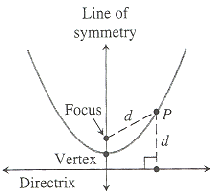 The mathematical definition of a parabola is that the distance from the focus to any point on the parabola will be equal to the distance between that point and any point on the directrix. This definition plays a role in the properties of a parabola because the parabola has to be focused around the focus, so if we draw our parabola with the exact distance from the focus to any point to the directrix, we will have the perfect shape that the parabola needs to be. The mathematical definition of a parabola affects its shapes because it determines how fat or skinny it is.
2. How does the focus affect the shape of the conic section?
The focus affects the shape of parabolas because the parabola curves around the focus, so that is why the parabola is a curve. It also affects the shape of the parabola because the distances from the focus to the directrix have to be equal in order for the shape of the parabola to be accurate.
 3. How do the properties of this conic section apply in real life?
One example of a parabola in real life is a bouncing ball. When a ball bounces it travels in a parabolic path. We can say that the ball bounces, goes up to its highest point (or the vertex) and comes back down. Parabolas can also be used in satellite dishes. Satellite dishes work by having waves bounce of from the satellite dish to the center of the satellite which would be the focus.

Parabolas :) This website has more information on parabolas!
Citations:
Parabola image posted from: http://www.personal.kent.edu/~rmuhamma/Algorithms/MyAlgorithms/Gifs/parabola-2.gif
Bouncing ball image posted from:
https://blogger.googleusercontent.com/img/b/R29vZ2xl/AVvXsEi0EPWWQKV1Sjm5paUqFrPU0riSln-xwcDPpJQp22xGxLcfteSFGRfV-gvTlXD_OGTpz_WXf8pfA1L-v6ZhftpXNplOhU3A9A91-cvcseMNr0ZGpXVAwnleCzNAPqWs-m2G0gwLrzIVIKg/s1600/Bouncing+Ball.png
Satellite image posted from:
http://dingo.care2.com/pictures/c2c/share/19/190/011/1901182_370.jpg
The mathematical definition of a parabola is that the distance from the focus to any point on the parabola will be equal to the distance between that point and any point on the directrix. This definition plays a role in the properties of a parabola because the parabola has to be focused around the focus, so if we draw our parabola with the exact distance from the focus to any point to the directrix, we will have the perfect shape that the parabola needs to be. The mathematical definition of a parabola affects its shapes because it determines how fat or skinny it is.2. How does the focus affect the shape of the conic section?
The focus affects the shape of parabolas because the parabola curves around the focus, so that is why the parabola is a curve. It also affects the shape of the parabola because the distances from the focus to the directrix have to be equal in order for the shape of the parabola to be accurate.
3. How do the properties of this conic section apply in real life? One example of a parabola in real life is a bouncing ball. When a ball bounces it travels in a parabolic path. We can say that the ball bounces, goes up to its highest point (or the vertex) and comes back down. Parabolas can also be used in satellite dishes. Satellite dishes work by having waves bounce of from the satellite dish to the center of the satellite which would be the focus.

Parabolas :) This website has more information on parabolas!
Citations:
Parabola image posted from: http://www.personal.kent.edu/~rmuhamma/Algorithms/MyAlgorithms/Gifs/parabola-2.gif
Bouncing ball image posted from:
https://blogger.googleusercontent.com/img/b/R29vZ2xl/AVvXsEi0EPWWQKV1Sjm5paUqFrPU0riSln-xwcDPpJQp22xGxLcfteSFGRfV-gvTlXD_OGTpz_WXf8pfA1L-v6ZhftpXNplOhU3A9A91-cvcseMNr0ZGpXVAwnleCzNAPqWs-m2G0gwLrzIVIKg/s1600/Bouncing+Ball.png
Satellite image posted from:
http://dingo.care2.com/pictures/c2c/share/19/190/011/1901182_370.jpg
Subscribe to:
Posts (Atom)